Last year I decided to take the plunge and run my first marathon. Being local to the Washington D.C. area, the Marine Corps Marathon was the obvious choice and my schedule allowed just enough time to train. Completing a marathon is no small event, and I wanted to share some of the insights I picked up along the way for anyone else looking to knock out their first.
Training Plan
Initially, I planned to run the marathon with another person to help support them on their weight loss journey. It all seemed like such a good idea at the time. My partner had run a marathon previously, so I trusted the training schedule he developed to get us adequately prepared for the event. Little did I know, he just used ChatGPT. At any rate, even though he ended up dropping out of the training program half way through, I decided to stick with it and it worked out well enough for me.
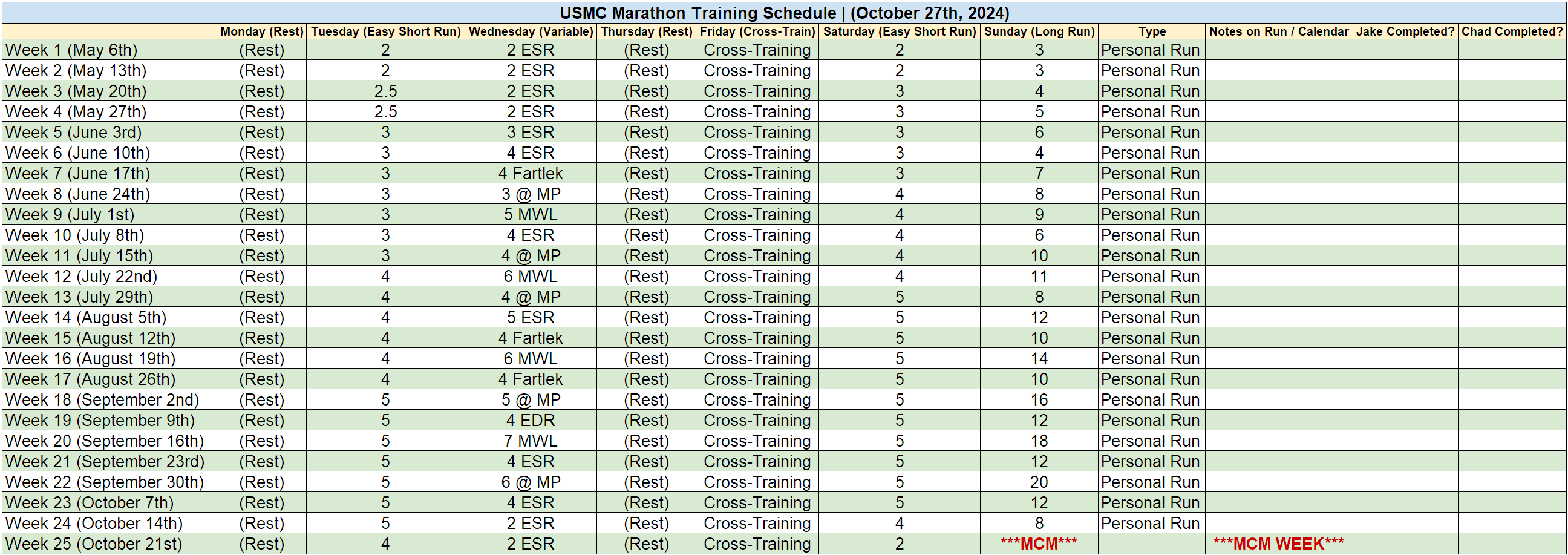
My goal was simply to finish the marathon within the allotted time limit, which this training plan helped me accomplish. That said, there are a few things I would adjust. As crazy as it sounds, one of the biggest changes I would make is to run more than one 20-miler. I think these really get you as close as possible to race conditions and help prepare your body and mind the most. Additionally, I would occasionally turn the prescribed runs into tempo or Fartlek runs, and I think adding these variations in was really beneficial.
One thing that transformed my training was focusing on heart rate, not pace. This is where having a Garmin watch comes in handy. A friend recommended setting my pace to my heart rate – 150 beats per minute. This is enough to keep you moving but not enough to kill your body. Having the Garmin not only allows you to do this, but you can modulate and adapt your training based on conditions (heat, hills, etc).
With an adequate training plan in place, try not to focus too hard on having the perfect run with perfect conditions every day. Some days will inevitably be better than others. It is better to focus on consistency and putting in the effort even on days when you don’t feel like it. That said, sometimes life gets in the way. I had to miss a month of training in June due to JRTC (Army training, living in the woods for 30 days). If you can’t control it, let it go. It’s a dichotomy you’ll have to get comfortable with. After returning from my Army training, I just picked up where I would have been in the program and everything worked out.
Nutrition
At some point during my training, I learned about a running phenomenon called bonking. Scientifically, bonking is the term for the sudden onset of fatigue and loss of energy when your body is depleted of glycogen stores. For marathon runners, it often occurs between miles 18 and 20. Well, it turns out, you can run out of gas much earlier than that if you’re not paying attention to your nutrition. I remember my first 10 miler on the schedule, I thought I was going to die. I ran it after work and probably hadn’t eaten enough food. It was awful.
What I learned was the necessity of nutrition planning for pre-, mid, and post-run. I conducted all of my weekly long runs on Sundays, and while I could do them anytime on Sunday, I quickly realized that I perform my best first thing in the morning. But the prep starts before that. Saturday nights became carb night. Pizza, pasta, whatever carb heavy food that I was in the mood for. Then, Sunday mornings I would eat a donut and have a big cup of coffee before taking on my long run. Turns out, giving your body the fuel it needs to perform actually makes a difference. Like, a night and day difference. It was incredible!
But I didn’t stop there. For mid-run calories I experimented with a few things before settling on GU brand energy gels. They’re not the best tasting, but they work. And they don’t get stuck in your teeth like gummies or melt like chocolate. I’d hit one every 45 minutes on long runs. Post-run was basically whatever I wanted to refuel. I’d be pretty wiped out for the day so I often ended up getting fast food. Probably not ideal, but after a long run I wasn’t in the mood to care.

Gear
There are only a few pieces of gear that I would recommend. Using actual running shoes makes a big difference. It feels like they almost pull you along. I’ve been using Altra Escalante’s for years and I really like them. I experimented with different vests, mostly trying not to drop the cash for one of the expensive ones from REI. In the end, I did and it was worth it. Some cheap amazon chest rigs work ok for short distances, but on longer runs they’d put some ugly chafing on my arms. This isn’t to say you absolutely need an expensive running rig, but if you’re serious about running, its worth it.
I already talked a little about the Garmin watch. I’ve had a Garmin Fenix 5 since about 2020. It’s worth the plunge just for the extra data points you get when training, and the heart rate monitoring is key for marathon training. Finally, you’ll want to get a pair of high-quality socks. I have some wool Darn Tough socks that are ankle height. Wool is key because it’s moisture wicking, meaning it pulls sweat and moisture away from your skin thus minimizing the risk of blisters. They also have a nice thickness on the bottom that act as a little extra padding.
Personal Care
Now for the not-so-hot topic of personal care. For some reason, when my long runs hit 14 miles, the need for nipple pasties suddenly and urgently became a requirement. Holy crap, it’s something you’ll experience once and then never want to experience again. Around that time, I also started using Aquaphor on the insides of my thighs for the same reason. Again, experience it once and you’ll never want to repeat it. It may vary for others based on distance or climate, but I’d recommend having these items on hand and using them when your mileage starts going up. Otherwise, you might find yourself stepping into the shower after a long run and feeling like your most sensitive parts are getting hit with a blow torch. Super not fun.
Race Day
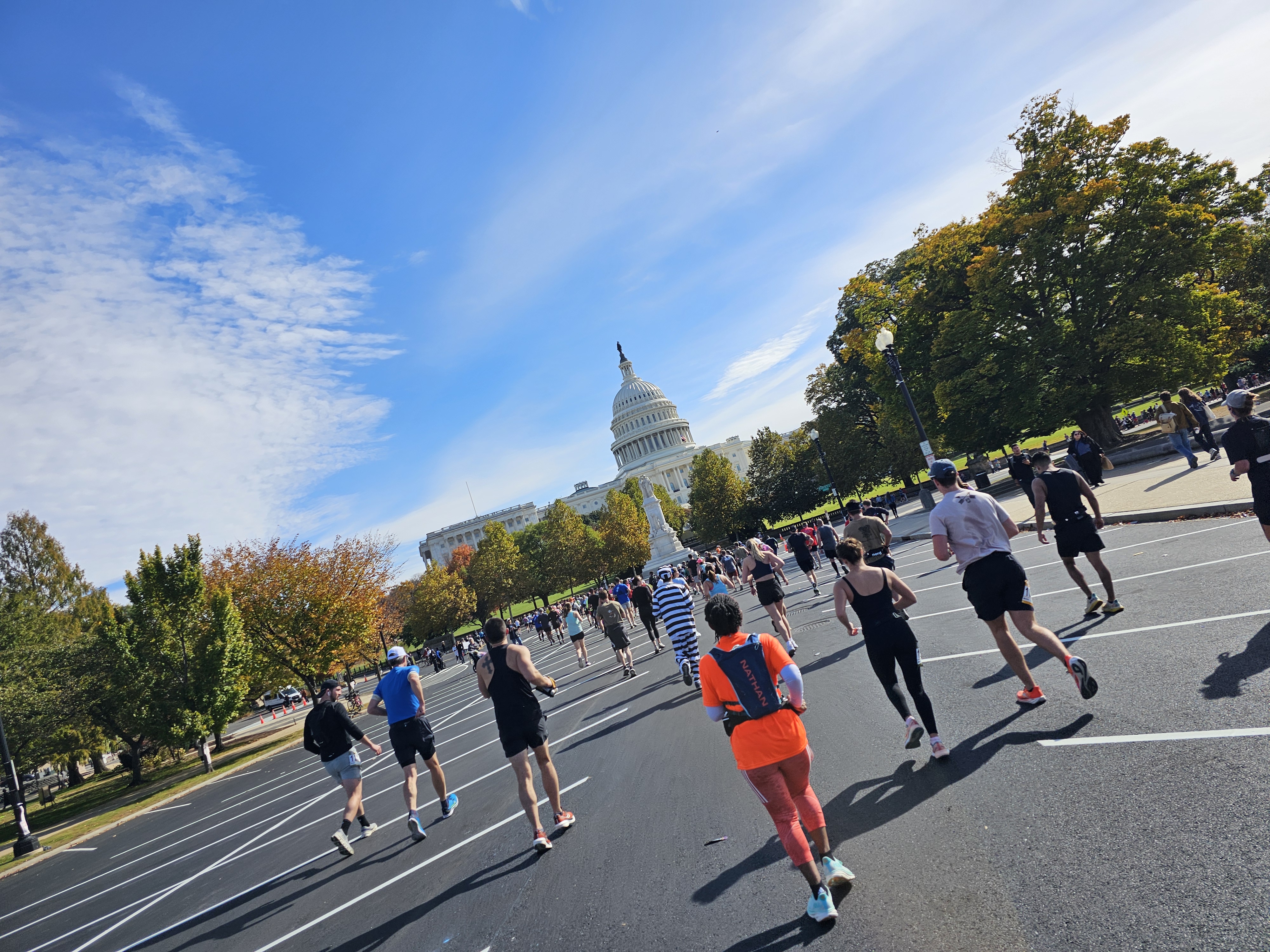
The big day! But your prep for race day really starts weeks prior when you do the 20-miler. What I mean is, you should use the 20-miler as a dry run for race day. Wear the exact same shoes, socks, clothes, and vest. Do your nutritional prep all the same. Everything should be as identical as possible to race day. Put differently, you shouldn’t be doing anything new on race day, to include using new gear, eating new foods, etc. The last thing you want is an unexpected stomach ache or blister throwing everything off when it’s game time.
You’ll also want to really focus on pacing. By this time, you should know what your target marathon pace will be. Stick to it! It’s so easy to get going with a crowd and accidentally run much faster than you intend, which could then lead to potential bonking issues down the line. Hit your stride and stick with it to the end! Which leads me to my next point…
Don’t stop! And by stop, I mean walk. I ran pretty easily through 19 miles. Then through 19 to 20 I seemed to feel more onset of fatigue in my legs. So, I figured I’d walk and recover for a bit before picking back up and finishing out the race. What a mistake! What I didn’t realize was that my feet and legs had more or less gone numb at that point. I think what happened was the brief period of walking allowed the blood flow and feeling to come back into my legs. When I tried to pick things back up and run, the pain was excruciating. I ended up walk-running the last 6 miles with pain that was completely off the charts. Moral of the story, don’t stop!
Conclusion
While training for the marathon, I had the chance to sit with an active-duty Green Beret during one of my work trips. We got on the topic of doing hard things like Ranger school or running a marathon, and he mentioned how he likes to do a gut-check activity every year, just so he knows he still has it. It was something I’d felt but never verbalized to myself. Not saying I’m anywhere near the level of an SF guy, but for me it was sort of an, “aim for the sky, land among the stars,” kind of thing. I never imagined I’d get to a point where I’d have 10 miles on the schedule for the day and think, “Oh thank god, only 10 miles!”
Overall, I’m glad I ran the marathon. I’ve never been a good runner or even fond of the activity, which is mostly why I felt the need to do it. I was talking with a friend afterwards, and they mentioned that it’s almost something you’d want to put on your resume. Because you can look at someone who’s run one and think, “I know where you’ve been (mentally) because I’ve been there too.”


 Gearset | Skillset
Thanks for this. Super helpful. Do you recommend the Marine Corp Marathon in general? I’ve seen it online and it looks intriguing.
LikeLike
Yeah! The MCM is known as the people’s marathon because it’s one of the largest marathons it is open to everyone.
LikeLike